
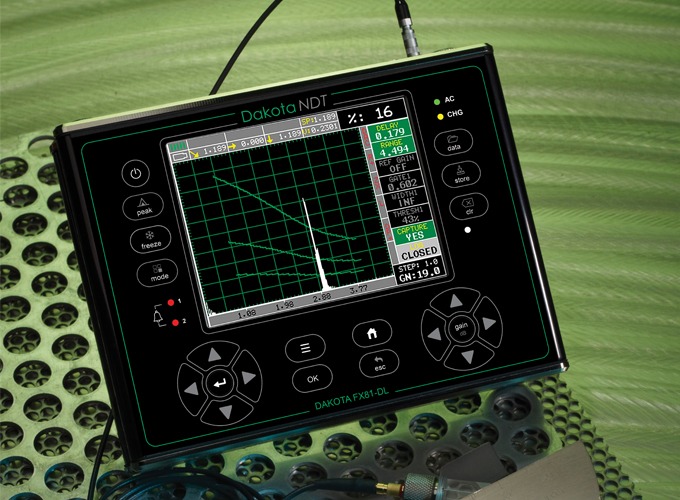
Dakota NDT’s range of portable and benchtop ultrasonic flaw detectors combine all the functionality of state-of-the-art flaw detection with advanced material thickness capabilities.
Using ultrasonic soundwaves, these advanced units can be used to locate and size hidden cracks, voids and similar discontinuities in welds, forgings, turbines, and other structural components.

Frequently Asked Questions
Ultrasonic flaw detection is a nondestructive test (NDT), it involves sending a sound signal into a part and listening for a reflection. A reflection can indicate the presence of a defect inside the materials.
The gauges create an electrical pulse that is sent into the material. A transducer connects to the device and converts the electric pulse into a physical vibration. The vibration travels into the material. A defect will reflect a vibrate back into the transducer. The transducer coverts the physical vibration received into an electrical signal, and this is displayed on the screen of the flaw detector device for interpretation by a person, or AI system and reported.
Both a Thickness Gauge and Flaw Detector use the same technology, of sending and receiving a signal to identify a difference. The thickness gauge is primarily to report thickness changes. A flaw Gauge is more complex and can identify small issues and size the defects. The user of the flaw gauge would have additional qualifications to interoperate the signals and report the findings.
Dakota NDT's Flaw Detectors combine state-of-the-art flaw detection with advanced material thickness capabilities.