
Precision Measurement of Thin Metallic Machined Parts with the Dakota PCX8-DL Precision Thickness Gauge
Application Overview:
Today the user-friendly Dakota PCX8-DL Precision Thickness Gauge is supporting customers in the Aerospace, Automotive, Food and Chemical processing industries.
This article discusses the Dakota PCX8-DL Precision Thickness Gauge. It will explain how this gauge when used in conjunction with its 15 MHz transducer will accurately measure thin metallic parts. This is typically required in the quality control of manufactured products, goods in/out inspections, corrosion monitoring of extremely thin parts and the measurement of small diameter tubes.
Critical measurement of components to ensure build quality is within tolerance is a vital part of any manufacturing and maintenance process. Cost implications for errors can be catastrophic. Fortunately, highly accurate dimension verification is possible by combining a Precision Ultrasonic Thickness Gauge with a high frequency (HF) Transducer. The result is a solution capable of achieving measurement resolution to 0.001mm/0.0001”.
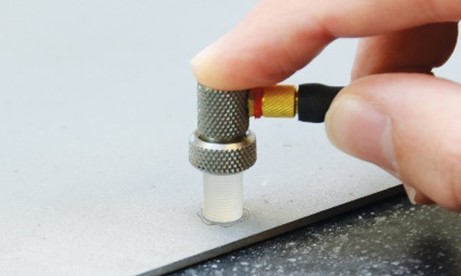
Single Delay HF Transducer – Explained:
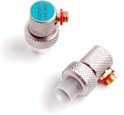
All ultrasonic transducers use a crystal to convert an HF electronic pulse into a HF vibration. The HF vibration travels through the material being measured. Timing how long HF vibration takes to pass through the part and return is measured and converted from a time to a distance by the gauge.
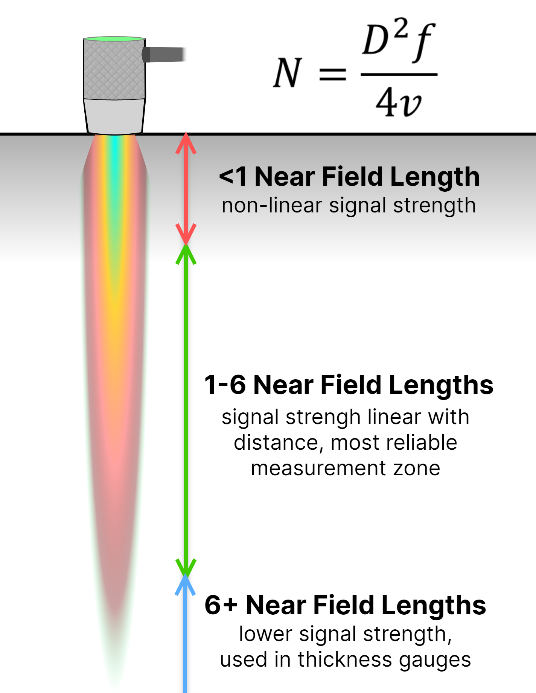
Transducer selection is critical to the measurement performance. Certain factors determine the optimal field range, this is also known as the Near Field (NF). The Transducer NF depends on transducer crystal frequency and diameter. The resolution improves with increased frequency.
In practice, it is not physically possible to have the optimal range to begin at the face of the transducer, it is also a significant challenge to read instantaneously the pulse and receive signals. To overcome these challenges the delay is added to the front of the transducer face. This extends the optimal range into the NF region and adds an electronic recovery time between the pulse and receive signals.
Measurement Methods and Range
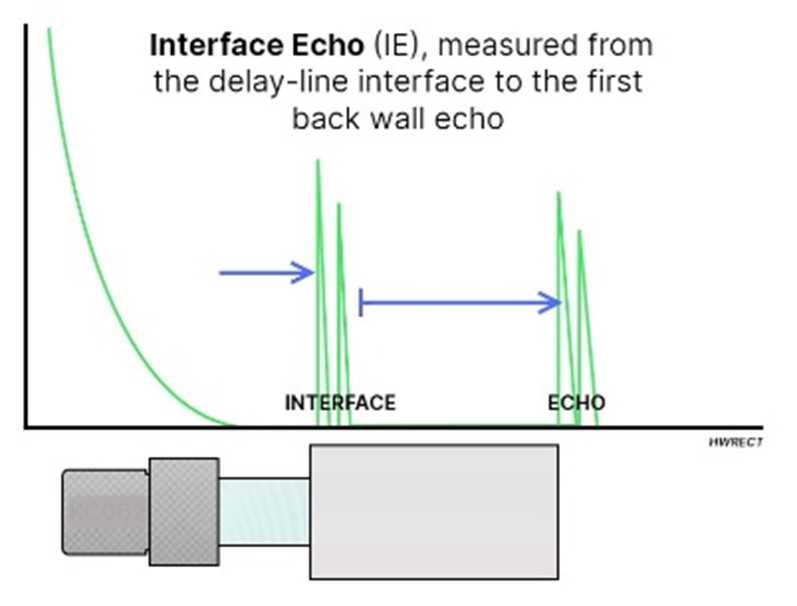

IE 1.65mm to 25.4mm (0.065” to 1.0”)
IEE 0.15mm to 10.15mm (0.006” to 0.4”)
Dakota gauge used in this application:
For more details on how the Dakota PCX8-DL Precision Thickness Gauge can give an advantage to your inspection process.