
Avoiding Measurement Error on Thin Parts with an Extra Resolution Transducer
Application Overview:
The minimum thickness that a digital gauge can measure depends on the transducer you use. The transducer frequency and diameter control the near field (NF) length, which sets the transducer measurement range.
In steel, a standard twin crystal 5 MHz 0.25” transducer usually measures a minimum thickness of 2mm. A standard twin crystal 5MHz 0.5” transducer measures a minimum thickness of 4mm.
An Extra Resolution Transducer reduces the NF distance and the minimum detectable thickness. This is particularly useful and must be considered to reduce inspection risk when measuring very thin corroded parts.

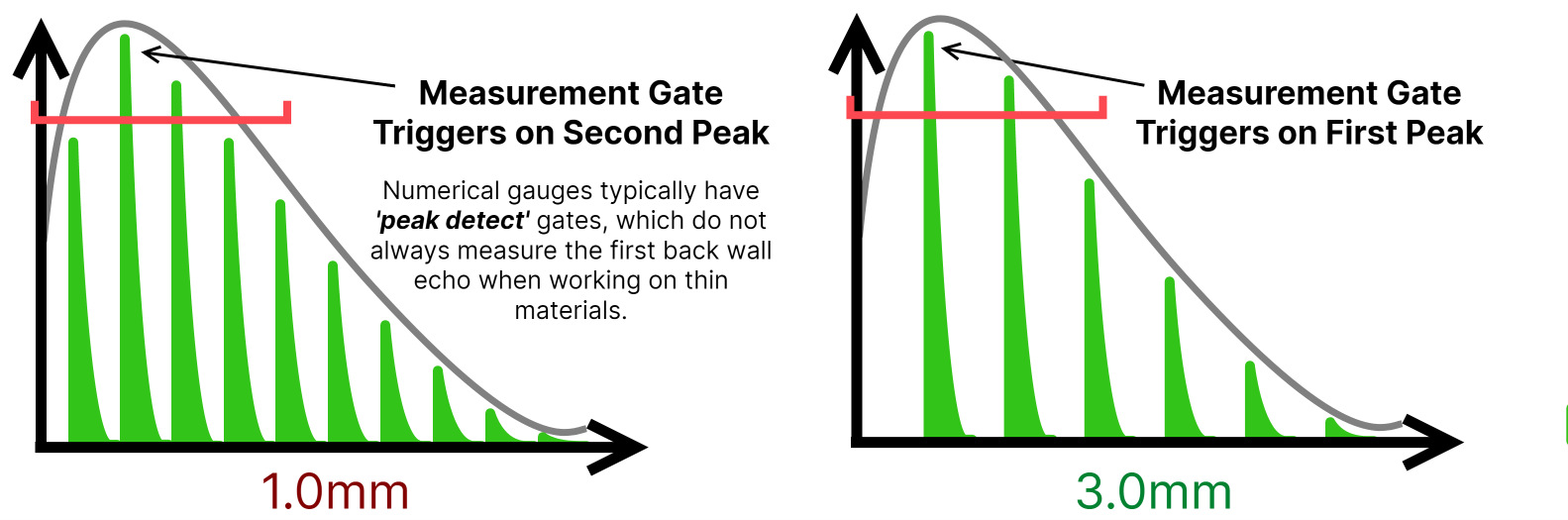
Potential Detection Error with a Standard Dual Element Transducer:
It is important to note that a transducer’s signal strength reaches its maximum at the near field point.
As the material thickness decreases, the amplitude of the second repeated reflection can potentially surpass that of the first reflected signal.
While digital thickness gauges automate various measurement settings, including gate settings, the occurrence of total wall loss in areas affected by corrosion must be carefully considered.
Inspection Risk:
Some transducers have an NF distance that is so large that they can never measure a very thin material. But, they might measure the second or third reflection, which can make you think the total remaining thickness is more than it really is.
To address this issue, the use of an Extra Resolution Transducer is strongly advised for thin materials when readings below 5mm are expected. (The Extra Resolution Transducer – TXC7M500CP-4 is capable of measuring a minimum thickness of 0.75mm/0.030”, providing enhanced accuracy in critical applications.)
You can see this effect easily on a step block. Connect a standard transducer to a digital thickness gauge and measure the 1mm and 2mm steps. Both will read as 2mm.